Montenegro's Food Culture Is Smaller Than You Expected and Deeper Than It Looks
Adriatic seafood and mountain fare split between coast and interior, with konoba traditions and rakija rituals that quietly anchor daily expat life there.
8 min read
In a country the size of Connecticut, the food changes completely between the coast and the mountains, and both versions are served with a generosity that the portions alone do not explain.
Quick Takeaways
- •Montenegrin food culture splits cleanly between coastal Mediterranean and mountain Balkan traditions with surprisingly little overlap
- •The konoba — traditional tavern — is the primary social eating space, and its menu reflects whatever the owner caught, grew, or preserved
- •Njeguški steak and pršut from the Njeguš village carry a regional pride that exceeds their modest appearance
- •Rakija is offered with the same social weight as Georgian wine, and declining requires more cultural dexterity than accepting
Montenegro's food culture operates on a scale that matches the country itself — small, intense, and surprisingly varied for its size. The coast offers Adriatic seafood in preparations that owe as much to Italian and Croatian influence as to anything distinctly Montenegrin. The mountains offer dense, meat-heavy, cold-weather food that shares DNA with Serbian and Bosnian traditions. Between these two zones, separated by less than a hundred kilometers of winding road, the cuisine changes so completely that a single day's drive can take you from grilled octopus to smoked ham without leaving the country.
For expats, Montenegro's food culture is less about discovering a national cuisine and more about learning to eat locally in a place where local means the village, not the country. The fisherman in Kotor serves what he caught that morning. The farmer in Cetinje serves what his family has preserved since autumn. The konoba — the traditional tavern that functions as dining room, social club, and cultural archive — serves whatever the owner has decided is good today. This smallness of scale, which would be limiting in a larger country, becomes intimate in Montenegro, and the food benefits from the intimacy.
Two Kitchens Divided by a Mountain Range
The Montenegrin coast — Budva, Kotor, Herceg Novi, Tivat — eats Mediterranean. Grilled fish, calamari, black risotto with cuttlefish ink, octopus salad, and mussels from the Bay of Kotor define the coastal table. The olive oil is local. The wine is Vranac from Lake Skadar vineyards. The fish is sold from boats at small harbors, and the freshness is verified by the simple fact that you can see the fishing vessel from the restaurant terrace.
The mountain interior — Cetinje, Kolašin, Žabljak, Nikšić — eats Balkan. Smoked meats, thick stews, kačamak (a dense cornmeal and cheese dish), cicvara (a butter-and-cheese porridge), and kajmak (a clotted cream) dominate tables that are set against landscapes of peaks and pine forests. The fat content is high. The flavors are deep. The portions are designed for people who spend days in cold air, and they deliver warmth with every bite.
For expats, choosing between coast and mountain is also choosing between food cultures. Living in Kotor means eating Mediterranean, shopping at the fish market, and drinking wine. Living in Kolašin means eating hearty, shopping for smoked products and preserved vegetables, and drinking rakija. Both are excellent. Both are affordable. And both are genuine in a way that resists the homogenization that tourism often imposes on small countries — partly because Montenegro is still new enough to tourism that its food culture has not yet learned to perform for outsiders.
Some of this only really lands when you hear someone else describe it. Memoirs about learning a language late, or about the first winter somewhere unfamiliar, tend to be honest in a way guides rarely are. Audible's first 30 days are free — which is usually enough time to find one book that changes how you read the rest of this.
Affiliate disclosure: the Audible link above is an affiliate link. If you start a trial through it, Expat Blueprint may earn a small commission at no extra cost to you. It never changes what we recommend. Read the full disclosure.
Land Well takes this further than an article usefully can — 70 pages built around one question: how will daily life actually work there? See what it covers.
Njeguški Pršut and the Village That Punches Above Its Weight
Njeguš — a small village nestled in the mountains above Kotor — produces a smoked ham that has become Montenegro's most recognizable food product. Njeguški pršut is dry-cured in mountain air, smoked over beech wood, and aged for months in conditions that the village's altitude and climate provide naturally. The result is a ham with a depth of flavor that bears comparison to Italian prosciutto or Spanish jamón, though the production scale is incomparably smaller.
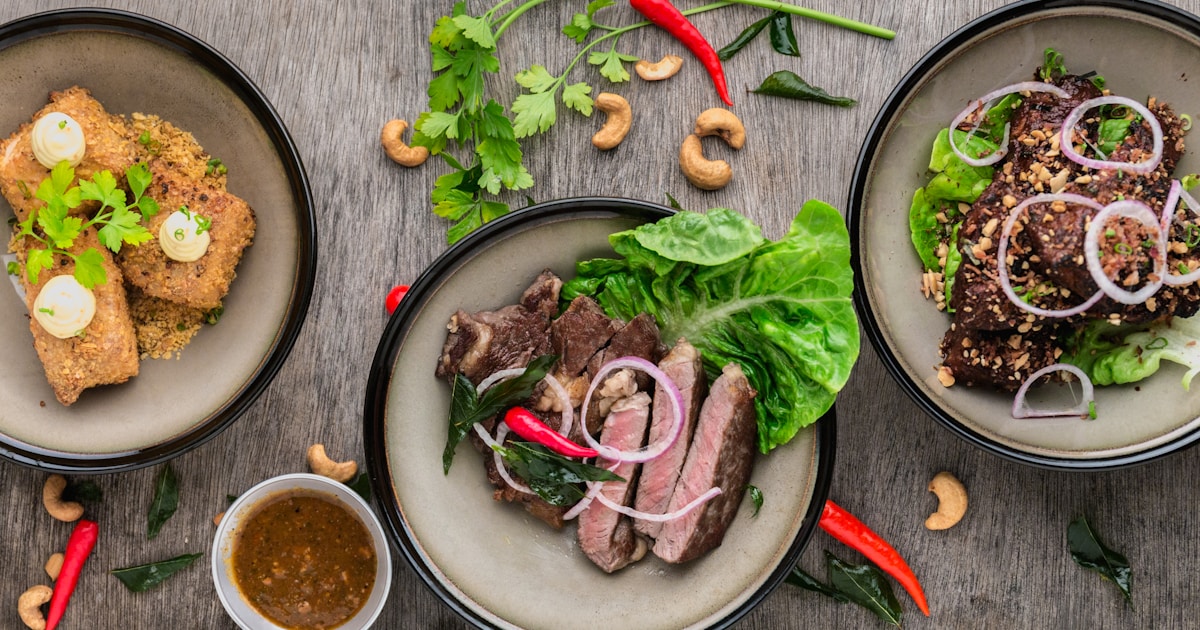
The Njeguški steak — pork stuffed with pršut and kajmak, then grilled — is the dish that most restaurant menus in Montenegro offer as a signature item. At its best, made with genuine Njeguški pršut and freshly made kajmak, it is exceptional. At its worst, made with generic ham and industrial cream, it is merely adequate. The gap between these two versions teaches an important lesson about Montenegrin food: provenance matters more than preparation, and the best food comes from the most specific sources.
For expats living near the coast, a drive up to Njeguš to buy pršut directly from a producer is a routine outing that combines scenic beauty with culinary investment. The producers sell from their homes, often slicing samples for tasting before purchase, and the prices — while higher than supermarket ham — reflect a quality that supermarket distribution cannot match. The pršut hangs in the smokehouses that are visible from the road, and seeing it in its production context makes each subsequent slice taste better.
Rakija Is Not a Drink — It Is a Welcome
Rakija — fruit brandy, typically made from grapes or plums — occupies the same social space in Montenegro that wine occupies in Georgia and that tequila occupies in Mexico. It is offered to guests automatically, consumed before meals, and produced domestically by families with sufficient fruit and a still that may or may not comply with any regulation.
The ritual is specific. Rakija is served in small glasses, at room temperature or slightly chilled, and consumed in sips rather than shots. The first glass accompanies conversation about health, family, and the weather. The second glass, if offered, accompanies conversation about more personal matters. The third glass usually accompanies food. And the offer itself — extending the bottle, filling the glass without asking — is a gesture of welcome whose refusal requires genuine reason and gentle delivery.
For expats, rakija culture is unavoidable and, for most, eventually enjoyable. The homemade versions vary wildly in quality — from smooth, fragrant distillations that rival fine brandy to harsh, paint-stripping productions that challenge even generous palates. Learning to distinguish good rakija from bad is a practical skill, and praising a host's rakija when it genuinely deserves praise opens doors that more formal social gestures cannot. In Montenegro, as in much of the Balkans, the homemade bottle is a test and a gift simultaneously, and navigating it well is a social skill worth developing.
Markets in Montenegro Are Small, Personal, and Often Someone's Backyard
Montenegro's food markets operate on a scale that reflects the country's size. The pijaca — the open-air market — in Podgorica or Nikšić is modest compared to Croatian or Serbian equivalents, but it serves the same function: daily access to produce, dairy, and preserved goods from local farms. The vendors are often the farmers themselves, selling what they grew, and the quantities reflect a food system that operates on proximity rather than logistics.
In smaller towns and coastal villages, the formal market may not exist. Instead, the food supply chain is interpersonal. The neighbor sells eggs. The woman down the road sells cheese. The fisherman posts his catch on a social media group, and buyers drive to the harbor. This informality, which would be disorienting in a larger country, works in Montenegro because the distances are short and the community is small enough that trust substitutes for regulation.
For expats, adapting to this small-scale food system requires patience and social investment. The first month involves finding sources: who sells the best tomatoes, where to get honey, which konoba uses genuinely local ingredients. The second month involves building relationships with those sources. By the third month, the food supply chain is established — personal, reliable, and connected to the landscape in a way that makes every meal feel grounded. This connection is one of Montenegro's quiet gifts, and it compensates for the limited variety that a small country inevitably provides.
Montenegro's food culture undergoes a dramatic seasonal shift that expats experience as two distinct eating lives. Summer on the coast is Mediterranean: light, fish-based, salad-heavy, accompanied by rosé wine and eaten outdoors with views of the Adriatic. Winter in the mountains — or even winter on the coast, which is quieter and cooler than most expect — is hearty, meat-based, stew-heavy, accompanied by rakija and eaten indoors with the warmth of a wood stove.
The transition happens quickly. September's cooling temperatures bring the first stews. October's olive harvest changes the oil from last year's to this year's. November's first frosts signal the beginning of the preserving and smoking season. By December, the food landscape has transformed entirely, and the grilled octopus of August feels as distant as summer itself.
For expats who experience a full calendar year in Montenegro, this seasonal cycle becomes one of the most satisfying aspects of living here. It creates anticipation — the first warm day that means fish on the grill, the first cold night that means kačamak by the fire. It creates structure — the preserving work of autumn, the hearty meals of winter, the lightness of spring. And it creates a relationship with food that is inseparable from the landscape, the weather, and the passage of time, which is perhaps the most ancient and most human way to eat.
Small Country, Deep Table
Montenegro's food culture does not have the range of larger countries or the international reputation of its neighbors. What it has is depth — a relationship between food and place that is compressed by the country's size into an intensity that larger food cultures spread thin. The fish from the bay, the ham from the mountain, the rakija from the neighbor: these are not just foods but coordinates on a map so small that you can taste the entire country in a weekend.
For expats, this smallness becomes intimacy. You know where your food comes from because the source is visible from your window. You know who prepared it because the konoba owner is someone you see at the market. You know what season it is because the table tells you. Montenegro's food culture is not sophisticated in the way that French or Japanese food culture is sophisticated. It is honest in a way that sophistication sometimes obscures, and that honesty, experienced daily, is its own form of excellence.
Written by
Carl S Moller
Founder & Editor, Expat Blueprint
Carl S Moller is the founder and sole editor of Expat Blueprint. He researches and writes every guide himself, working from immigration ministries, tax authorities, national statistics and recent first-hand reporting rather than claiming to have lived in all sixteen countries covered.
Keep the thread going
One reflective note every few weeks, and 20% off anything in the workbook shop the moment you sign up. The code is valid through 31 August 2026.
Unsubscribe any time. We never share your address. The 20% code is valid through 31 August 2026.