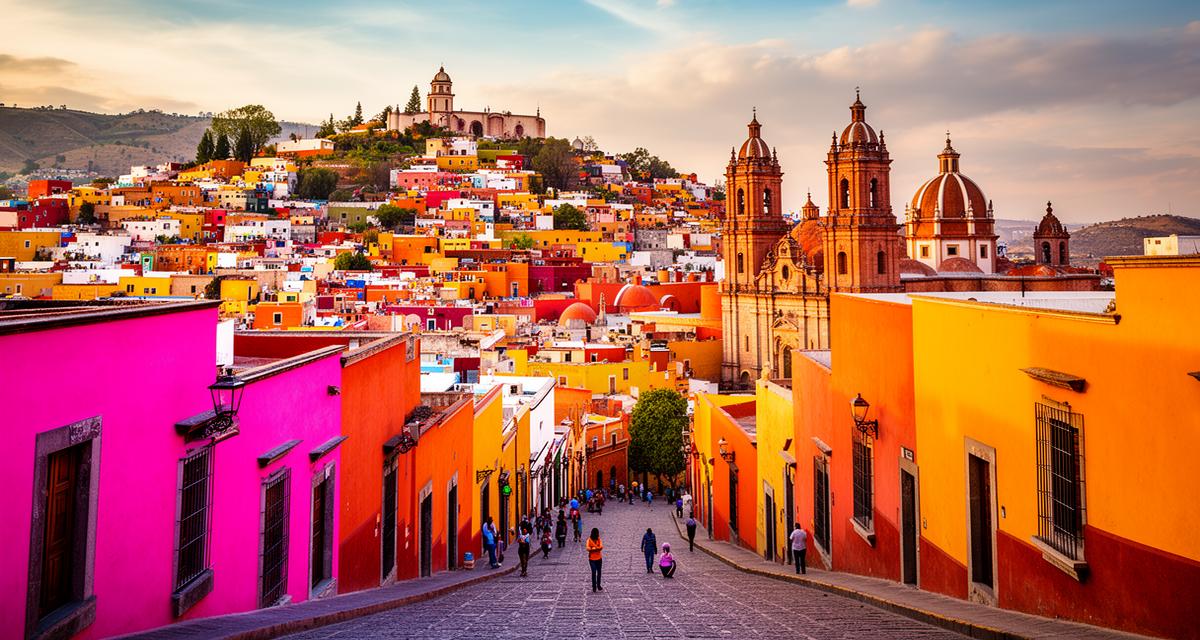
San Miguel de Allende: The Beautiful Bubble and What It Costs to Live Inside
A beautiful colonial town with a large expat population, rising prices, and the tension between authentic Mexican life and an increasingly curated bubble.
9 min read
San Miguel de Allende has been named the best city in the world so many times that the claim has become self-fulfilling. The cobblestone streets are immaculate. The light is extraordinary. And the expat community is so established that you can live a complete life without ever needing to speak Spanish — which tells you something important about what this town has become.
Quick Takeaways
- •San Miguel's cost of living is 40-60% higher than comparable Mexican cities, driven by expat demand and tourism infrastructure
- •The foreign population — primarily American and Canadian retirees — has created a parallel social world with its own institutions
- •Spanish is unnecessary for daily life in the centro, which is either a comfort or a warning depending on your perspective
- •The town's beauty is genuine and well-maintained, but the maintenance is partly funded by displacement of working-class Mexican residents
- •San Miguel works beautifully for what it is — the question is whether what it is matches what you came to Mexico to find
San Miguel de Allende occupies a unique position in the landscape of expat Mexico. It is not a discovery. It is not emerging or underrated or a hidden gem. It has been a destination for foreign artists since the 1930s, a retirement haven since the 1960s, and a globally branded luxury destination since the 2000s. Condé Nast Traveler has named it the best small city in the world multiple times. Its colonial architecture is a UNESCO World Heritage site. Its real estate market operates at price points that would be unremarkable in Santa Fe or Provence but are extraordinary by Mexican standards.
All of this makes San Miguel easy to dismiss as inauthentic, as a theme-park version of Mexico designed for wealthy foreigners. That dismissal is too simple. San Miguel is a real Mexican town with real Mexican residents, real cultural depth, and a history that precedes its current incarnation by centuries. But it is also a place where the expat presence has reshaped the social and economic landscape so thoroughly that the town functions, in many ways, as a bilingual, bicultural entity whose Mexican character is increasingly curated for foreign consumption.
How San Miguel Became San Miguel: A Brief History of Foreign Enchantment
The foreign presence in San Miguel de Allende began with art. In the late 1930s, an American named Stirling Dickinson arrived and helped establish the Escuela de Bellas Artes, which attracted a wave of American artists and writers drawn by the quality of the light, the low cost of living, and the town's architectural beauty. After World War II, the GI Bill funded American veterans to study abroad, and San Miguel's art schools became popular destinations. By the 1950s, the town had a small but established Anglo artistic community that coexisted with — and was largely dependent on — the local Mexican population.
The transformation from artist colony to retirement destination occurred gradually over the following decades. The artists attracted visitors, the visitors noticed the climate and the architecture and the prices, and some stayed. By the 1990s, San Miguel had developed a reputation in American and Canadian retirement circles as an affordable, beautiful, culturally rich alternative to domestic options. Real estate agents began specializing in foreign buyers. English-language newspapers and magazines appeared. The infrastructure of an expat community — churches, clubs, charity organizations, English-speaking doctors — grew organically.
The twenty-first century brought luxury tourism and global branding. Boutique hotels opened in restored colonial mansions. International restaurants and galleries replaced modest tiendas. The UNESCO designation in 2008 cemented the town's status as a cultural destination, and the travel magazine accolades that followed turned San Miguel into a global brand. Today, the foreign population is estimated at ten to fifteen percent of the town's roughly 80,000 residents, but their economic impact is disproportionate — they own or rent the most desirable properties, patronize the most visible businesses, and set the price expectations that increasingly define the local economy.
The Cost of Beauty: What San Miguel Actually Charges
San Miguel's cost of living occupies an uncomfortable middle ground: it is significantly more expensive than comparable Mexican cities but still cheaper than most American or European alternatives. A two-bedroom apartment in the centro histórico rents for eighteen to thirty-five thousand pesos monthly — roughly one to two thousand dollars — compared to ten to fifteen thousand pesos for similar quality in Querétaro, an hour away. Dining out at one of the centro's international restaurants costs three to five hundred pesos per person, compared to eighty to one hundred fifty pesos at a local fonda in a Mexican-majority neighborhood.
The price premium extends to everything that touches the tourist and expat economy. A cortado at a centro café costs sixty to eighty pesos — three to four times what you would pay in a café in a working-class colonia. Fresh produce at the organic market near the Jardín Principal costs double or triple the prices at the Mercado de San Juan de Dios, which serves primarily local residents. Even services like house cleaning and gardening, while still inexpensive by international standards, cost more in San Miguel than in nearby towns because the expat market has established higher baseline rates.
What makes these prices particularly striking is that they exist within a Mexican context. San Miguel is not expensive because its infrastructure is superior — the roads are cobblestone, the water supply is precarious, the internet is unreliable in many areas. It is expensive because demand from foreign residents and tourists has inflated prices to levels that reflect what the market will bear rather than what local costs would naturally produce. The result is a town where a retired American couple on Social Security income can live comfortably, while a Mexican teacher earning fifteen thousand pesos monthly is increasingly priced out of the neighborhoods they grew up in.
If this is the part you keep circling back to, Find Your Place is the workbook we built around exactly that question — where fits my life? See how it works.
The Other San Miguel: Where Mexican Life Continues
Beyond the centro histórico, San Miguel de Allende is a working Mexican town with the same structures, rhythms, and challenges as any municipality in Guanajuato state. The colonias that ring the centro — San Antonio, Aurora, Guadalupe — house the Mexican families whose labor sustains the tourist and expat economy: the housekeepers, gardeners, construction workers, waiters, and cooks who make San Miguel's lifestyle possible. These neighborhoods have their own markets, schools, churches, and social networks, and they operate largely in Spanish with little foreign presence.
The economic relationship between the centro and the surrounding colonias is complex and unequal. The jobs that the expat economy creates are real and valued — domestic employment in San Miguel pays better than in many comparable towns, and the construction industry thrives on renovation and real estate development. But the benefits are distributed unevenly. The wealth generated by tourism and foreign residency concentrates in the centro and in the hands of property owners, while the working-class residents who provide the labor face rising living costs without proportional income increases.
Some expats engage deeply with this reality through charity work, Spanish language study, and genuine cross-cultural relationships. The volunteer organizations in San Miguel do meaningful work — supporting schools, funding scholarships, providing medical care — and their contributions are acknowledged by the Mexican community. But charity, however well-intentioned, is not the same as integration. The fundamental structure of San Miguel remains a town where the most visible and economically powerful residents are foreign, and where Mexican culture, while celebrated aesthetically, is not the dominant force shaping daily life in the spaces where expats spend their time.
Who San Miguel Works For: An Honest Assessment
San Miguel de Allende works exceptionally well for a specific type of expat: someone who values beauty, cultural programming, community, and comfort, who has sufficient income to absorb the premium prices, who wants to live abroad without the friction of deep cultural adaptation, and who is comfortable with the knowledge that their experience of Mexico is partial by design. This is not a small or unworthy group. The desire for a beautiful, stimulating, affordable retirement in a warm climate is legitimate, and San Miguel delivers on that promise more reliably than almost any other destination.
It works less well for those seeking authentic immersion in Mexican life, for those on tight budgets, for younger expats and remote workers who want urban energy and nightlife, and for anyone who finds the expat bubble suffocating rather than comforting. The town is small — its walkable centro covers perhaps twenty blocks — and the social dynamics of a small, well-established community can feel claustrophobic. Gossip circulates. Social hierarchies, imported from American suburban life, reassert themselves. The newcomer energy that characterizes Mexico City or Mérida is largely absent.
The climate, while generally pleasant, has aspects that the branding obscures. San Miguel sits at 1,900 meters of altitude in a semi-arid landscape. Summer brings intense afternoon rains. Winter nights can drop to near freezing, and most colonial houses lack central heating. The water supply is precarious — the region faces chronic drought conditions, and rationing is common during dry months. These are not dealbreakers, but they represent the gap between San Miguel as experienced and San Miguel as marketed.
The Question San Miguel Raises: What Did You Come to Mexico For?
San Miguel de Allende is, in its way, a mirror. What you see in it depends entirely on what you brought. If you came to Mexico for beauty, warmth, affordability relative to the United States, and a ready-made community of English-speaking peers, San Miguel reflects back exactly what you hoped for. If you came to Mexico for Mexico — for the Spanish language, the cultural complexity, the productive discomfort of being a foreigner in a place that does not cater to you — San Miguel reflects something more complicated.
The town is not fake. Its architecture is genuine colonial heritage. Its light is real. The Mexican families who live here have roots that go back generations. The artisans in the surrounding countryside produce work of extraordinary quality. The cultural programming — concerts, exhibitions, literary events — is substantive and varied. All of this is real, and dismissing it as artifice is unfair to the many people, Mexican and foreign, who have invested their lives in this place.
But San Miguel is curated in a way that most of Mexico is not. The rough edges have been sanded down. The poverty is visible at the margins but absent from the spaces where expats spend their days. The cultural encounters are largely optional and controlled. You can have a wonderful life here without ever confronting the parts of Mexico that are difficult, contradictory, or uncomfortable. Whether that is a feature or a limitation depends, ultimately, on what you are looking for — and being honest about that answer is the most important thing you can do before signing a lease.
Beautiful, Real, and Partial
San Miguel de Allende does not deceive anyone. It is exactly what it appears to be: a stunningly beautiful colonial town with a large, well-established foreign community, premium prices, and a lifestyle that prioritizes comfort and aesthetics. The people who thrive here are those who see clearly what it offers and what it does not, and who have made peace with the trade-offs.
The only mistake is to arrive expecting something that San Miguel was never designed to provide. It is not a portal to deep Mexican immersion. It is not budget-friendly. It is not edgy or unpredictable or raw. It is a gorgeous, well-maintained, socially rich, and genuinely pleasant place to live — inside a bubble whose walls are visible to anyone willing to look. Whether you choose to live inside that bubble is your decision. But it should be a decision, not an accident.
Written by
Carl S Moller
Founder & Editor, Expat Blueprint
Carl S Moller is the founder and sole editor of Expat Blueprint. He researches and writes every guide himself, working from immigration ministries, tax authorities, national statistics and recent first-hand reporting rather than claiming to have lived in all sixteen countries covered.
Keep the thread going
One reflective note every few weeks, and 20% off anything in the workbook shop the moment you sign up. The code is valid through 31 August 2026.
Unsubscribe any time. We never share your address. The 20% code is valid through 31 August 2026.
The Parallel World: San Miguel's Expat Social Architecture
The expat community in San Miguel has built institutions so comprehensive that they constitute a parallel social world. The Biblioteca Pública, despite its name, functions primarily as an expat community center, hosting English-language lectures, film screenings, garden tours, and charity events. The Atención newspaper provides weekly English-language coverage of local events, real estate, and community news. Churches offer services in English. AA meetings run in English. Book clubs, bridge groups, hiking clubs, wine-tasting societies, and volunteer organizations operate in English and cater primarily to foreign residents.
This institutional completeness is either a tremendous comfort or a cautionary sign, depending on what you want from life in Mexico. For retirees seeking community, cultural stimulation, and an affordable lifestyle in a beautiful setting, San Miguel's expat infrastructure is genuinely excellent. The social calendar is full. The community is welcoming to newcomers. The support systems for aging — English-speaking doctors, pharmacy delivery, emergency contacts — are more developed here than in any other Mexican expat destination.
The cost of this completeness is insularity. It is entirely possible to live in San Miguel for years without speaking more than transactional Spanish, without forming meaningful relationships with Mexican neighbors, and without engaging with the Mexico that exists beyond the centro's photogenic streets. Many long-term residents acknowledge this with a mixture of regret and acceptance — they came for Mexico, in some abstract sense, but the Mexico they inhabit is a curated version designed for their comfort. Whether this matters depends on your reasons for being here, but it is worth being honest about the trade-off before you commit.