03 / Land
Land Well
Plan your arrival. Build a life that works. 70 pages, answering one question: How will daily life actually work there?
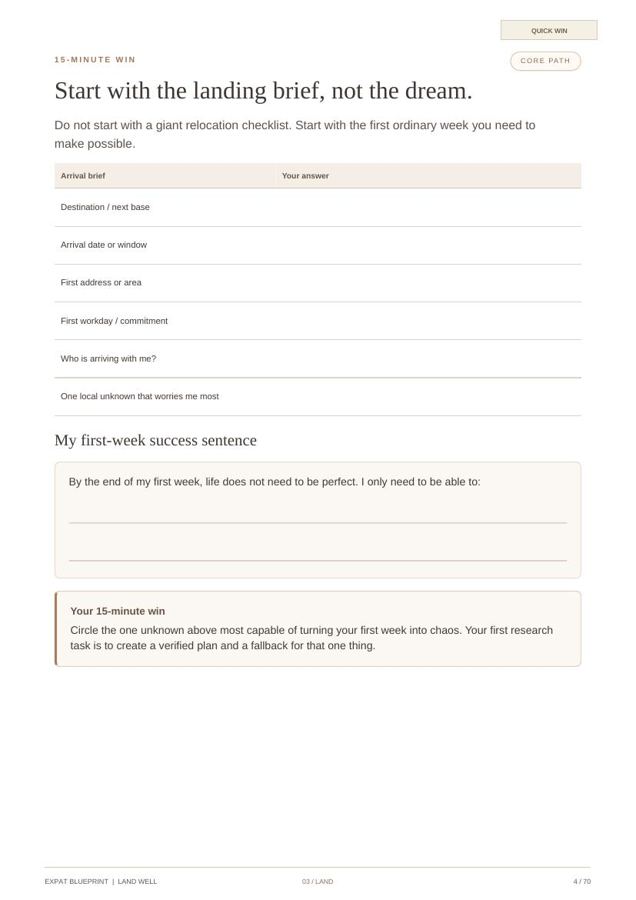
The move is usually not the hard part. The hard part starts about eleven days after arrival, when the novelty thins out and you notice that nothing repeats yet. Every errand is a small research project. Every week is improvised. You are not unhappy, exactly, but you are tired in a way that is difficult to explain to people back home.
This is where people quietly conclude the country was wrong, when in fact the setup was. A broken week and a bad destination feel identical from the inside, and almost nobody separates them before making a decision they cannot easily undo.
Land Well is the system for that stretch. It builds the minimum a first week needs before you arrive, then uses the weeks after to remove repeated friction until an ordinary week runs on its own.
Where you are
The move is happening, but the life on the other side is not functional yet.
Where it leaves you
No critical part of ordinary life in crisis mode, a week that runs without constant improvisation, and a clear next action for whatever is still weak.
How the workbook moves
Before you land — the Minimum Viable Arrival: sleep, access, connectivity, money, transport, food, health route, first workday, and a fallback for each.
The first 72 hours — arrival day, the first workday, and an early reality check against what you assumed.
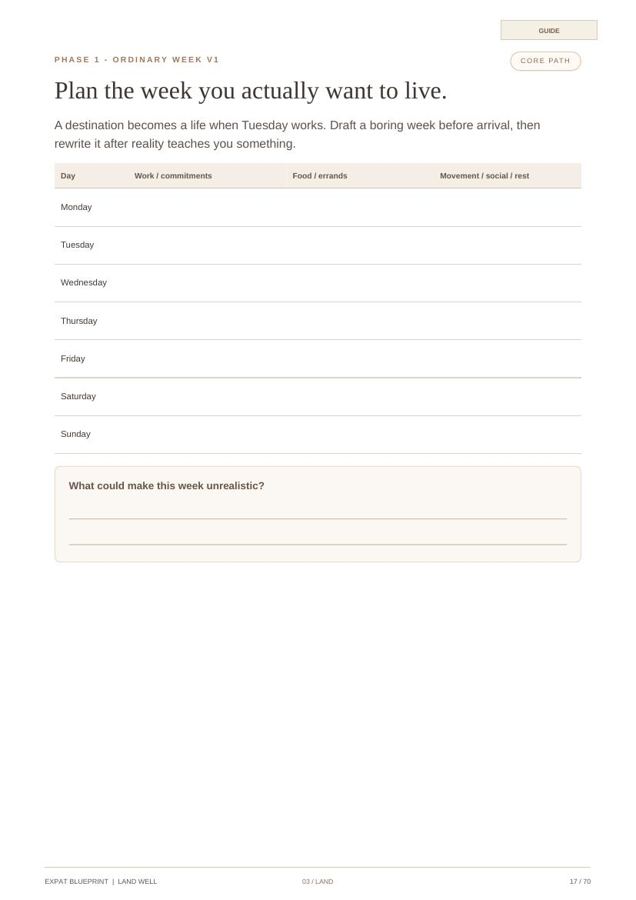
Days 4 to 30 — the Friction Log turns repeated irritations into a short queue of fixes, and Ordinary Week V2 rebuilds the week around what actually happened.
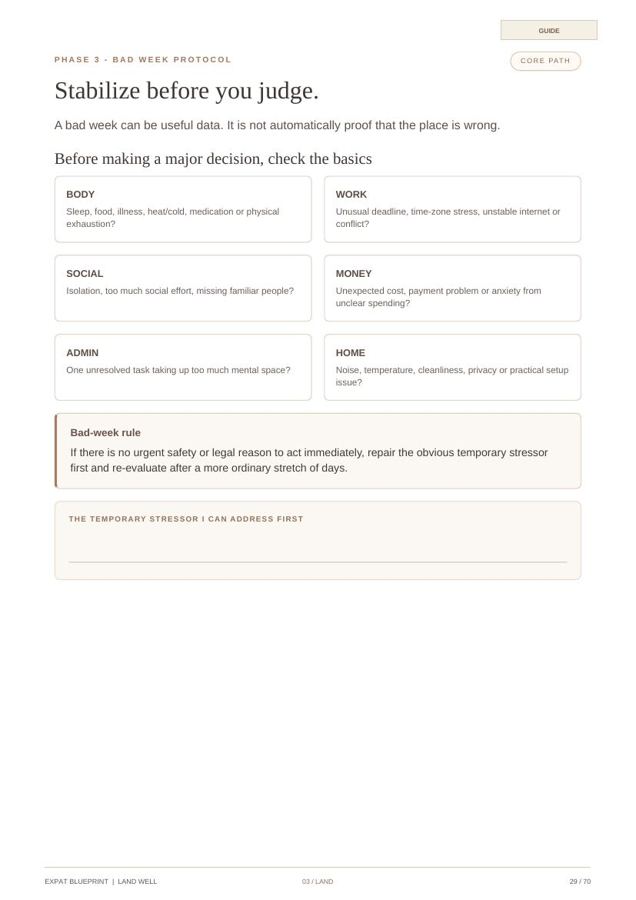
The Bad Week Protocol — stabilise body, work, money and connection before you allow yourself to judge the destination.
Days 31 to 90 — the Place vs Setup diagnostic, which asks the only question that matters at that point: is this country wrong, or is this arrangement wrong?
Pages from inside
Nothing here is decorative. Every page exists to move one decision forward or to stop you working on the wrong thing.
Where you start depends on where you are
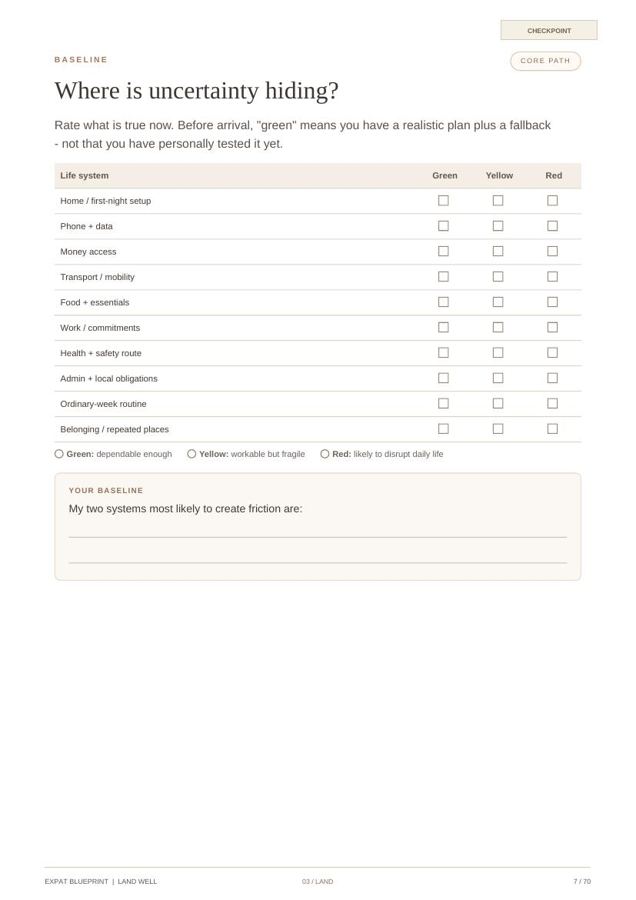
The workbook opens with four routes. You take one, and it tells you plainly what to skip.
2+ weeks before arrival
Build the Minimum Viable Arrival, the first 72 hours, fallbacks, the first-month operating budget and Ordinary Week V1.
Leaving within 7 days
Protect only what can break the first week: access, connectivity, money, transport, food and medication, first workday.
Already arrived
Start from the Baseline. Fix red systems first, then use the Friction Log. Do not reconstruct a perfect pre-arrival plan.
Having a bad week
Use the Bad Week Protocol before judging the destination.
What it is not
It does not choose the country, city or neighbourhood for you.
It does not untangle the home and obligations you are leaving behind.
It is not local professional advice. It helps you identify what must be verified locally, and by whom.
Questions
I have already arrived. Is it too late?
No — one of the four routes is written specifically for people who are already there and having a hard time.
Do I need the other two workbooks?
No. The boundary between the three exists to prevent repetition, not to create a dependency.
Format?
A 70-page PDF workbook, fillable or printable.
$49
70-page PDF workbook. Instant download, yours to keep and print.
The Complete Blueprint
All three workbooks — $89
This one plus Find Your Place and The Move-Ready Reset — the whole arc from deciding where to go to a week that finally runs on its own. Saves $28 against buying them separately.
See what the bundle includes